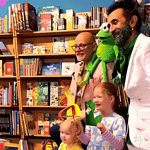
June is PRIDE month – a month that also sees the publication of Nen and the Lonely Fisherman, by Ian Eagleton and illustrated by me. It’s a special book in many ways. First of all it’s Ian’s stunning debut. Secondly, it’s published by a brilliant independent publisher Owlet Press. And lastly, it’s a picture book for primary school children with two men falling in love. Okay, so one of them is a MER-man… but even so…

The gorgeous graphic design is by Ness Wood
For many, many years, I couldn’t contemplate creating a book with same-sex characters falling in love. I wasn’t out myself, I was repressed, depressed, scared and scarred. It took a breakdown, the collapse of a marriage and two years of counselling before I could finally breathe, finally just let go… and exist… in a way heterosexual people do every day, without a moment’s thought.
I was fifty years old.
Coming out is a process. There are many layers, many wounds to heal, much to learn and accept and understand about oneself. But I knew one thing early on: this damage was laid down in childhood. This damage was in me, in my head. We often create our own monsters, but they grow from the messages, both overt and subliminal, that we are force-fed as children. The other side of this coin is simply an absence; as I look back at all the enduring classic tales, still read today, it’s as if people like me never existed.
Like most children around the world, I grew up with traditional tales. Here, in the West, we tend to call them fairy tales, although that always seemed a misnomer to me, as very few actually featured fairies. Yet, I loved them – from learning to read with Ladybird “Well Loved Tales” to the literary fairy tales of Andersen and Pushkin. The themes of heroes and rescue, love and redemption, magic and cunning excited me and set my imagination racing. But there was a problem: The Happy Endings.
Almost always, the tales ended with the hopeful girl getting her prince. Or the “lad” winning the hand of a princess. Marriage, success, status, equated to a Happy Ever After. The trope was filtered through to most other stories I read, most of the Sunday afternoon movies I watched. They were all “Fairy Tales” of a kind, because the plots had a similar structure (with a will they/won’t they romance). They almost always told me the same thing: Marriage was the answer. Specifically, heterosexual marriage. It was the only possible Happy Ending. Indeed these films and books manipulated you into wanting, hoping for such an ending. Anything else was designed to leave you in tears, as with Andersen’s own Little Mermaid.
To grow up, to go through primary education, and learn to read through stories that never once, even for a second, represent anything other than the heterosexist society we live in, is deeply damaging. Not just to kids who may be gay, but don’t quite know it yet, but also to all the other kids who grow up with the same message: straight is right and gay is wrong. How can they learn to empathise, to be supportive of those who are different to themselves? How can homosexuality ever be seen to be anything other than “wrong” when up to the age of 11 children are taught only “straight” stereotypes?
Despite great work from organisations like JustLikeUs, there remains a huge fundamental problem – many primary schools shy away from the subject – the usual cry of “It’s inappropriate for the age group” – oblivious to the fact that THIS is when the education is most needed. You can give a teenager as many LGBTQ+ books as you like (and there are some superb books out there now), but if they’ve already been taught to hate who they are, it’s too late. They will carry that sense of shame, of being “wrong” with them all their lives. I know. Because I am that kid. And I do carry those feelings around, and they still cut deep, to this day. Furthermore, it’s too late to teach empathy and acceptance in the wider community. Characters are formed, beliefs are entrenched.
Are LGBTQ+ picture books the last taboo? I think they are. Of course there have been a handful of books – mostly of a non-fiction type. Useful for teachers to take off the shelf for specific kids. But what children need is stories. Stories, that ALL children can enjoy that just happen to feature same-sex couples. And they are starting to appear, in fits and starts. My Daddies by Gareth Peter and Garry Parsons, and Grandad’s Camper by Harry Woodgate are two recent, excellent examples, that give me great hope for the future. But children need more. They need a new mythology, and a new canon of folk stories. They need fairy tales, with LGBTQ+ Happy Endings.
“Nen and the Lonely Fisherman”, beautifully produced and ardently supported by Owlet Press, is a tender, gentle, touching story of two same-sex individuals finding happiness together. How will the book be received? Will there be criticism? will the book be banned in some places?

(preliminary sketches for “Nen and the Lonely Fisherman”)
It has been suggested to me the book should come with an “advisory” sticker, so parents understand the book they are borrowing from the library has LGBTQ+ content.
But why should we? we don’t sticker books with black characters, or disabled characters, or any other “diversity” or “inclusion” category. We don’t sticker books to “warn” parents that the prince is going to kiss the princess. We think we have come a long way in terms of gay rights. Yet it is clear we are not there yet. We so often see illustrations of princes kissing princesses, holding hands, in romantic embraces, in books for the youngest children. We think little of it. Until we can show two men kissing in a fairy tale, we in the gay community, do not have equality. Homophobia still rumbles gently in the background, a hard-to-define, but ever present layer of subconscious, like sexism, misogeny and racism. I still don’t hold my partner’s hand when out in public. It felt really powerful to show Nen holding Ernest the Fisherman’s hand!

Fairy tales, for all their brilliance and beauty, for all their wisdom and imagination, are part of the problem. It has taken me all my many years to realise this.
So here is a new fairy tale, about a merman, who falls in love with a fisherman.
They hold hands.
They embrace.
They don’t kiss… yet.
But that time will come. And I am so happy this book is a stepping stone towards that moment. It’s a HUGE moment for me. Indeed, it is my very own
HAPPY ENDING!