
Let it snow! It certainly has snowed here in Hertfordshire. While I listen to my old Soviet recording of Rimsky-Korsakov’s opera Christmas Eve, I am thinking of the blini in the fridge. Perhaps a little Vodka and a quick hopak would be appropriate as well?
This is such a beautiful fairy-tale opera, and the story also inspired Tchaikovsky’s “The Tsarina’s slippers”, performed at Covent Garden this Christmas. I prefer Rimsky-Korsakov’s fantastic take on the story, which features a ballet of comets, a chorus of snowflakes and the goddess Kolyada, who symbolises the Russian Christmas Carols that celebrate the rising of the sun on Christmas morning.
Rimsky-Korsakov is sometimes criticised for his “puppet” operas, devoid of emotion. but I find the pageant-like celebration of tradition, and the fairy-tale ending surprisingly emotional.
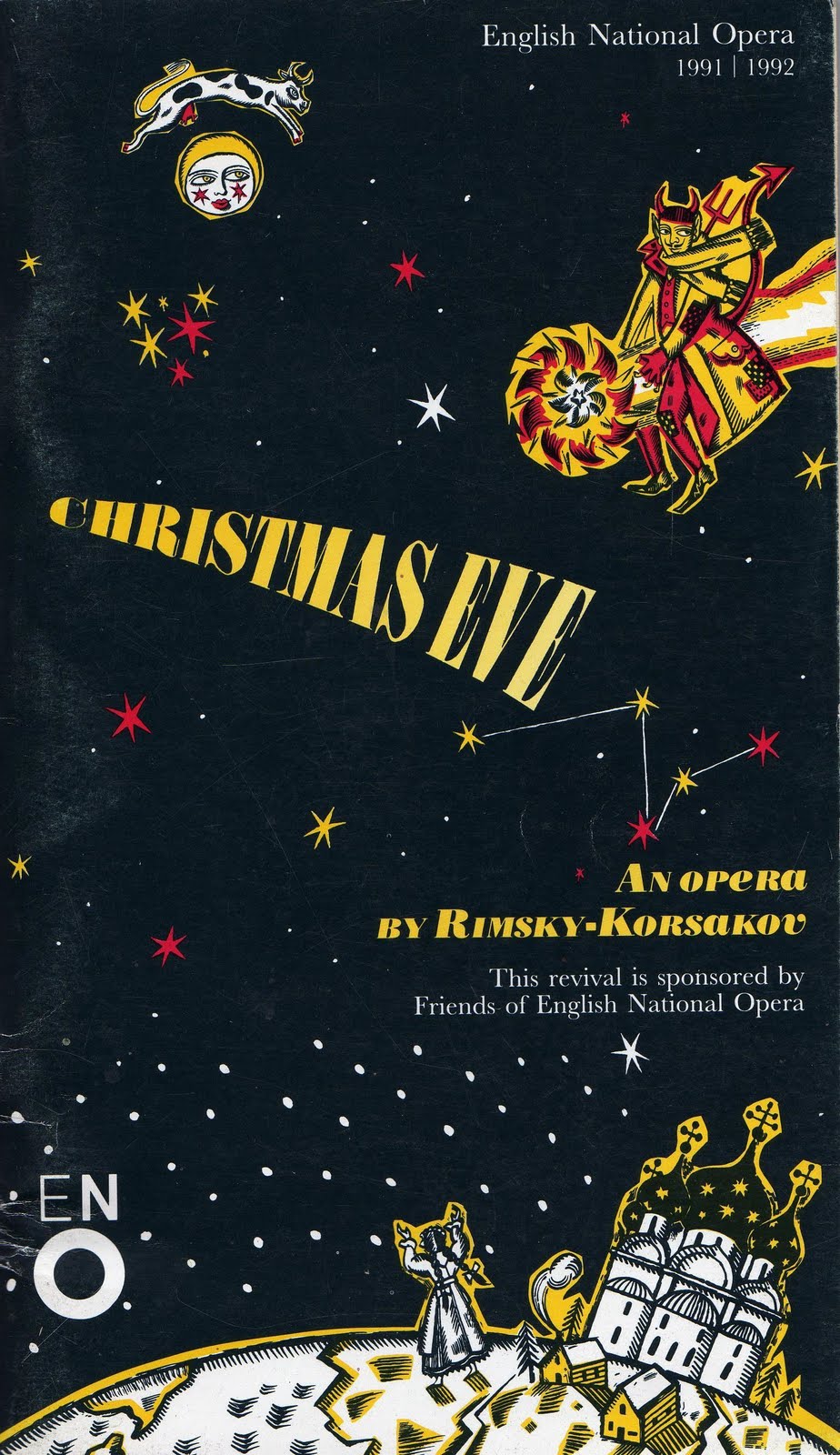
Many years ago the work was given it’s British stage premiere by the English National Opera in London. As a fan of Rinsky-Korsakov I went to the opening night – and six other performances. Each time I left the theatre on a cloud of joy and enchantment.
The story is set in the village of Dikanka in the Ukraine, drawn from a collection of tales by Nikolai Gogol. The Blacksmith Vakula adores the vain and indifferent Oxana. To complicate things, Vakula’s mother rather fancies her chances with Oxana’s wealthy cossack father. But HE won’t marry her because SHE is a witch.
In Slavic mythology, Christmas Eve is akin to Hallowe’en as a day of darkness before the light returns and Jesus is born. Because Vakula drew cartoons of the devil in the church, the devil and Solokha decide to take revenge, make mischief, and spoil Vakula’s courting of Oxana. To this end they steal the moon and the stars!
But Vakula still finds Oxana in the dark and tries to woo her. She declares to her friends that she would only marry him if he fetched her the Tsarina’s slippers.
Meanwhile the witch is so embarrased to have the devil himself in her kitchen that when several visitors call she hides him in a sack. Vakula thinks it is a sack of food and carries it off as he embarks on a reckless journey to see the Tsarina at the Winter Palace in St. Petersburg.
The devil reveals himself and Vakula, showing him a cross, gets the devil to carry him to St. Petersburg. An elaborate ballet of stars and comets accompaies them to the Imperial court, where Vakula eventually wins the Tsarina’s slippers.
Back in Dikanka, Oxana imagines the missing Vakula is eaten by wolves. Such is her joy when, on Christmas morning he returns, that she agrees to marry him with or without the slippers.
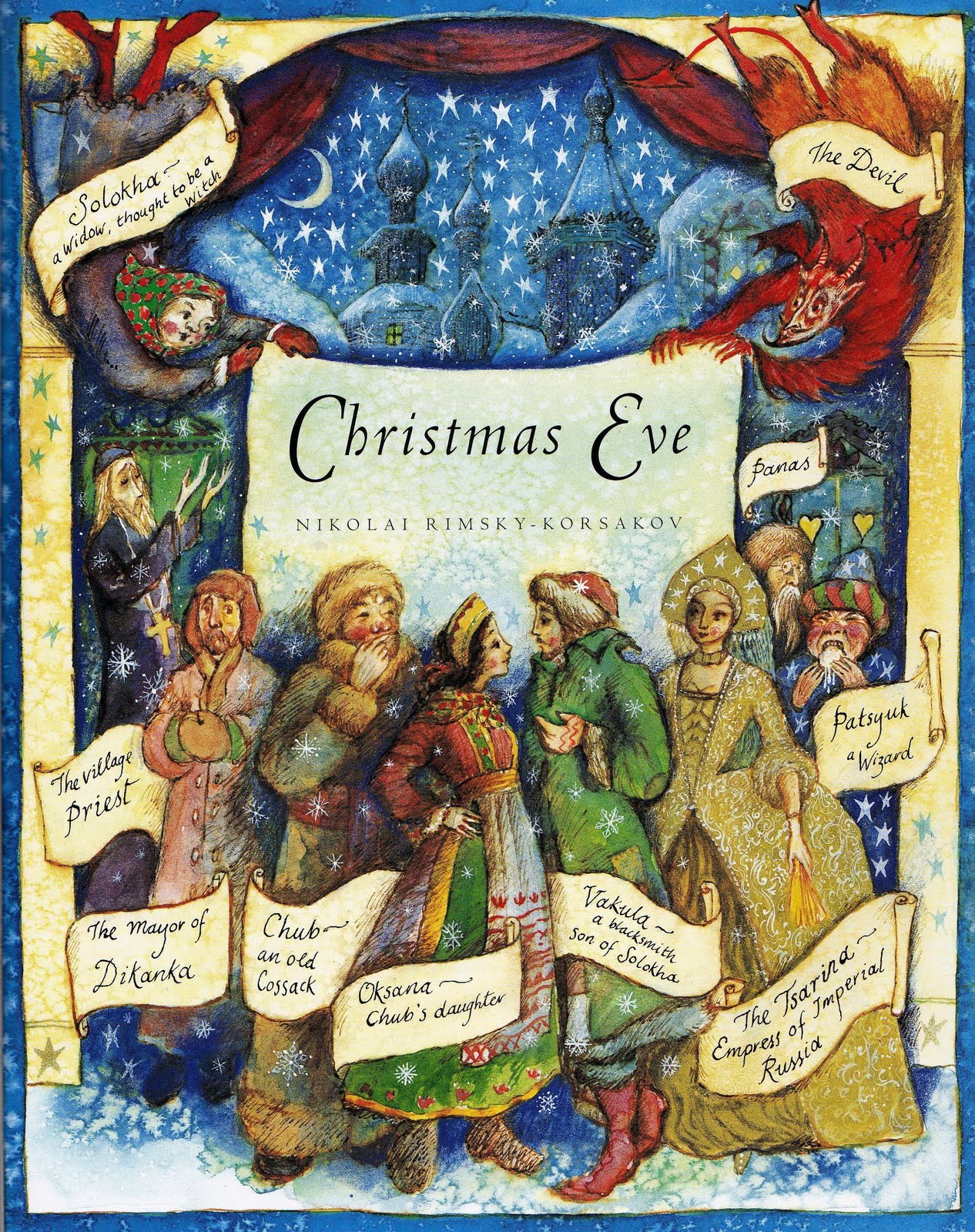
It’s an enchanting and very Russian story, filled with eccentric cameos, and I had the good luck to pursuade the author of the Barefoot Book of Stories from the Opera to include it, which enabled me to illustrate it. It remains my favourite story in the book. It’s such a shame it is so rarely performed – I remember it as one of the most spectaculaer and touching evenings at the opera I have ever enjoyed.
S’ Razhdеstvom!!!


Leave a Reply