
Remembrance Sunday…
How should we commemorate those who died in the two World Wars? The ubiquitous expressions: “Lest we forget” and “They shall not grow old” don’t go far enough. I’m sure they wanted to grow old…
The great children’s writer Hans Christian Anderson wrote: Where words fail, music speaks. Perhaps he was right. So, for me, this monumental day was spent with an orchestra…

There were concerts all over the country on Sunday November 11th 2018 – marking 100 years since the original armistice was signed, in a purloined railway carriage in Compiègne, France. But I was back in Hatfield, at the University of Hertfordshire, where I’ve been performing with the de Havilland Philharmonic and Robin Browning, the conductor, for over a decade.
Usually I perform with them in a family concert for children in November. By chance it often falls close to Remembrance Day. The orchestra wear poppies, but other than observe two minutes silence during rehearsals, the concerts have been very much aimed at children, with a very mixed and joyful repertoire.
This year, for the first time, the concert was November 11th. We knew at once what had to be done. The children’s concert was moved to December 16th (The Nutcracker), and a memorial concert was planned for this very special Centenary Remembrance Sunday.
Several fine composers – like poets – lived or died in The Great War, so it was entirely appropriate to feature them; Gurney and Butterworth, who both died, and Vaughan-Williams, who survived his time a stretcher-bearer. His The Lark Ascending has a transcendental effect upon the an audience, especially when played so rhapsodically as by Savitri Grier on this occasion.
The major work was Vaughan-Williams’s Pastoral symphony. This is not anything like Beethoven’s bucolic idyll. This is a landscape weeping, lamenting, mourning its destruction in the war.
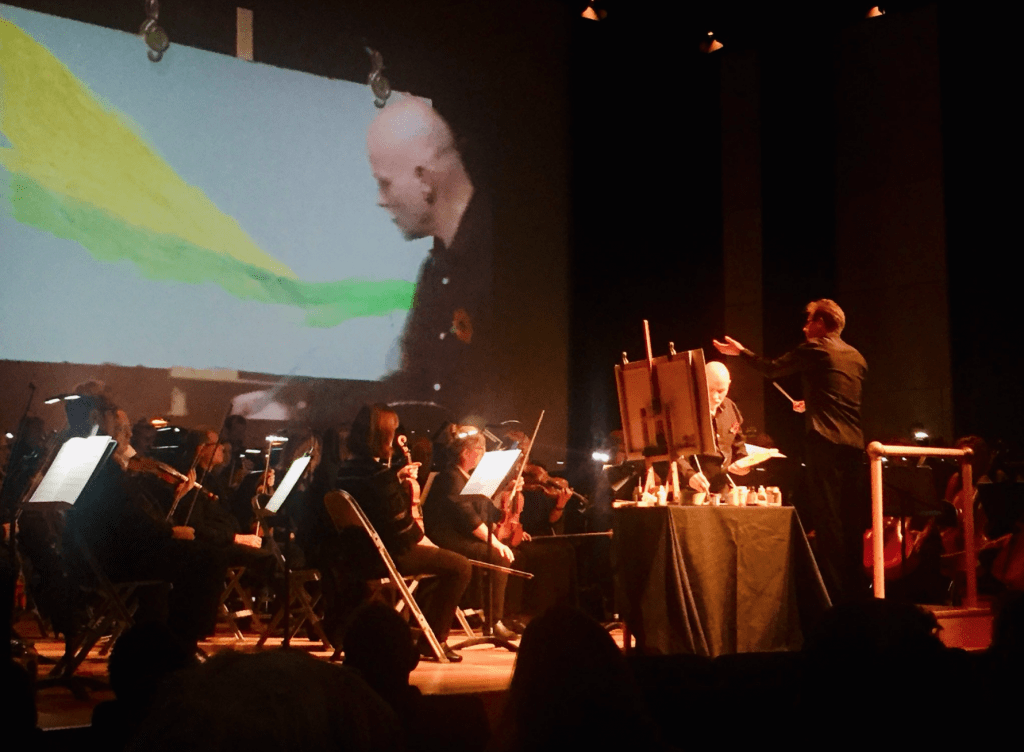
To paint scenes to match is no easy task; it is not strictly speaking a programme symphony; there is no story. But I have done so once before with Chetham’s Symphony Orchestra in Manchester. Then, it was to mark the centenary of the start of WW1; this time to mark the 100th anniversary of the end. On that occasion I read war poetry before each movement, and so did so again on this occasion, ending with McCrae’s “In Flanders Fields”, which gave us the overall title for the concert. So there were words. Their words.

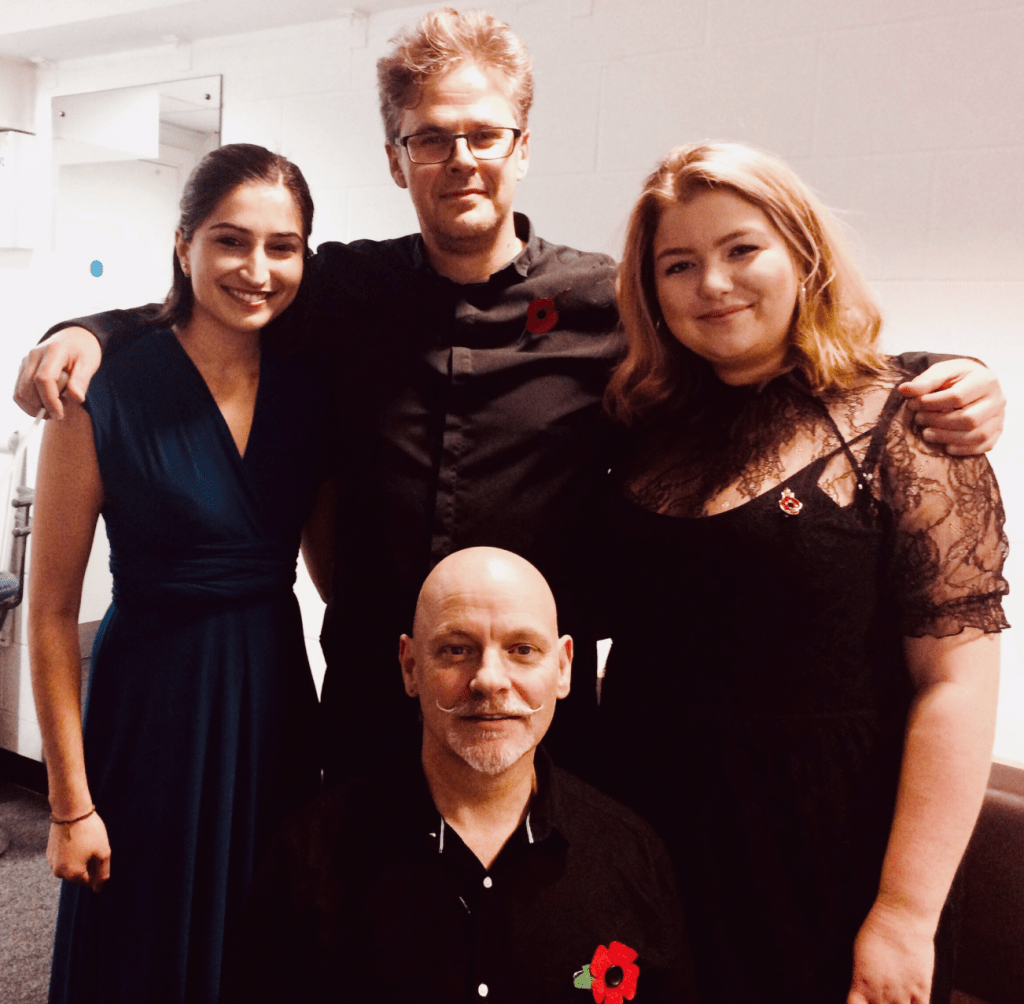
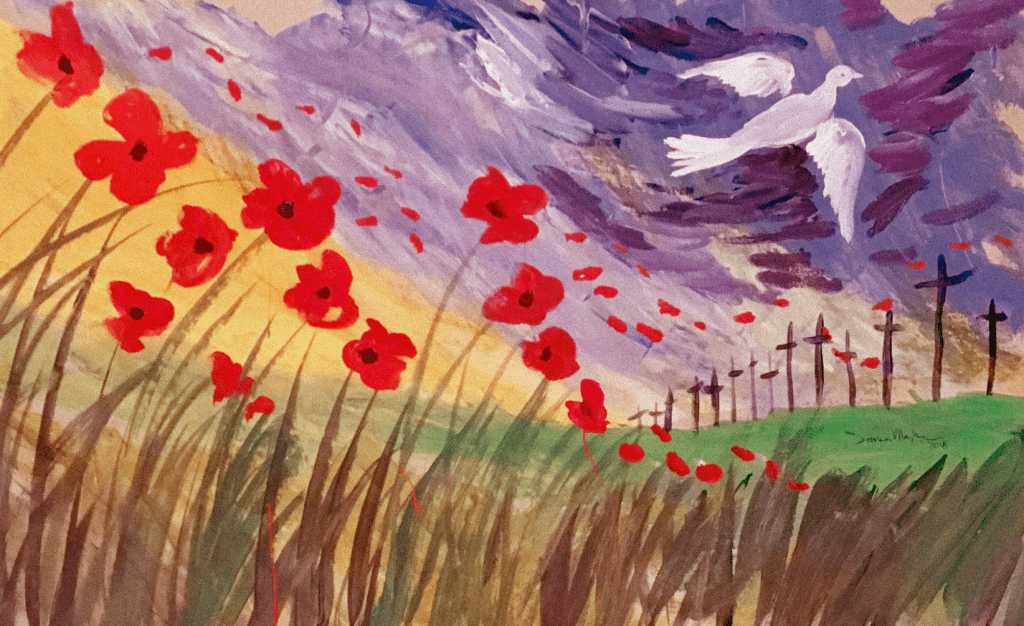
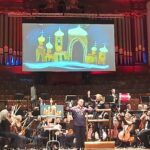
It was a packed, sold out theatre, and lovely to have a handful of friends there to support all of us on stage – this was truly a team effort. I was especially thrilled that the daughter of a family friend Madeleine McConnell-Smith was making her professional debut in the soprano solos in the symphony; the final movement begins, and ends, with a wordless vocal lament, almost like a requiem for the dead. As I painted a white dove and a field of poppies, their petals caught on a breeze, Maddy gave a rhapsodic account of the music, and was rewarded with a sincere and profound two minutes *silence* at the end… followed by very warm applause. Deeply moving. Maddy, who I’ve known since she was four, is only nineteen, and scored a great success.
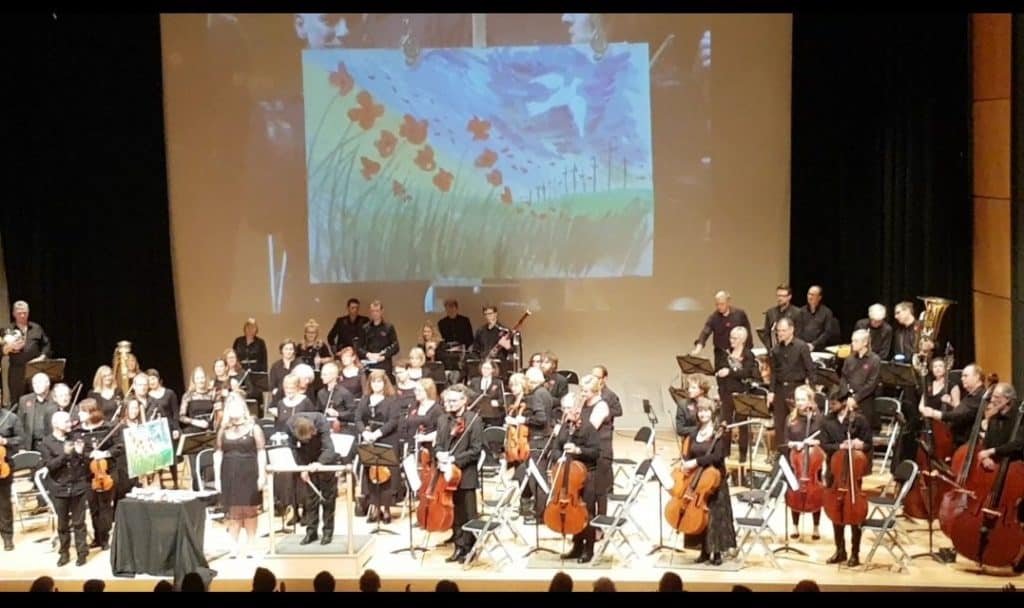

The whole occasion felt very special indeed, and I am, as ever, hugely grateful to the University of Hertfordshire Arts team (UHArts), the de Havilland Philharmonic, and Robin.
One thing that drifted in and out of my mind during the performance was how LUCKY we were to be sharing this music, these poems and art, how privileged that we are free to express our art, that we live, for now, in a free land. The arts may increasingly seem a frivolous add-on in education, but here was a wonderful example of its importance – historically, politically and as the catharsis of emotions as well. As evidence of civilisation, art performs a vital function: to remind us of the worst and to reflect back to us the best of our existence, and allow us the freedom to express it. War is, of course, a matter of life and death. But surely this freedom of expression is also what those men and women fought for? How grateful I felt to them at the end of an intensely moving performance.





Leave a Reply