

When Vaughan-Williams wrote “A Pastoral Symphony” it was widely misunderstood to be a reference to bucolic countryside scenes, like Beethoven’s 6th Symphony. In fact it was a response to the desecration of nature in WW1, which Vaughan-Williams experienced first hand as a stretcher-bearer in the trenches.
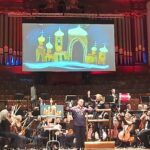
When conductor and head of music of the world famous Chetham’s Music School in Manchester first proposed a collaboration, it was clear this was going to be a little different to the usual children’s matinee that I work on. And it truly was. Weaving war poetry around the sections of the symphony, and interpreting the non-narrative but highly atmospheric music was a challenge unlike any other I’ve faced with these concerts. To end up doing so for a sold-out formal evening memorial concert at the Royal Northern College of Music was even more of a big deal.

This was all preceded by workshops for children, where they painted as musicians from the orchestra played extracts from the music for them; a matinee of the full symphony for families; And a workshop for the orchestra in painting to music. A full on few days, with any gaps filled up with rehearsals…

The final concert was an expanded programme beginning with Butterworth’s “A Shropshire Lad”. Butterworth died in the trenches and left little music, but some songs about the Shropshire Lad, and a new student work (by Francesca Rijks) inspired by the themes, preceded Butterworth’s orchestral rhapsody (which was the first piece I painted to). There then followed Beethoven’s 3rd Piano Concerto as a show case for the brilliant Chetham’s student Eudald Bach (and which I did NOT paint to!). Then, after the interval, the Pastoral was repeated once more.
For the first movement I depicted a lyrical landscape… but with autumn leaves and dark clouds gathering… Very much Rupert Brooke’s “Forever England”.
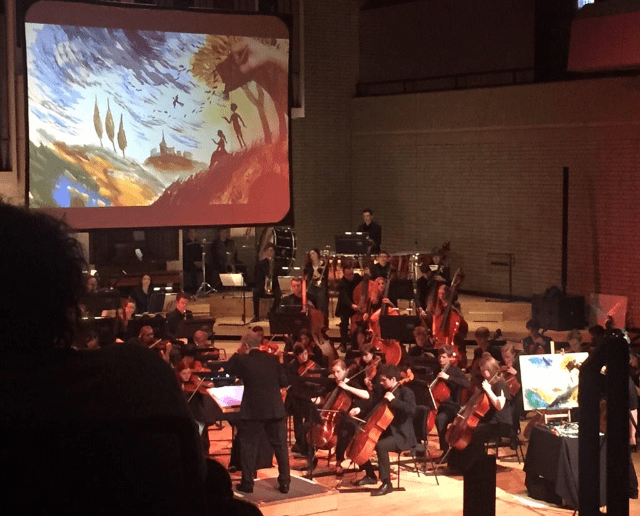
The second movement seemed to suggest the bleakness of the trenches, with the off-stage trumpet reminiscent of a bugle playing “The Last Post” (the composer heard an off-key performance on the Front which inspired him).
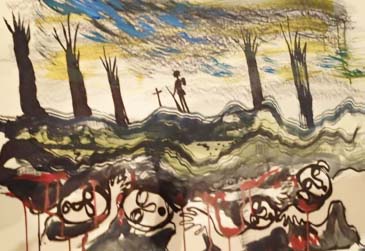
The fast-paced third movement got me thinking of War Horse…

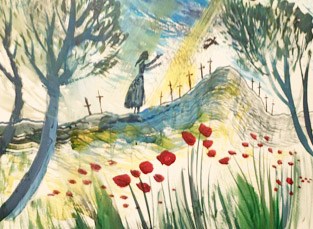
And the symphony ends with a heart-rending off-stage soprano solo – a lamenting woman – and a surging, blossoming theme that suggests new growth, and a return to life. Of course, fields of poppies were the perfect symbol, especially as the pictures were sold after the concerts for the British Legion Poppy Appeal. One was sold for £400!
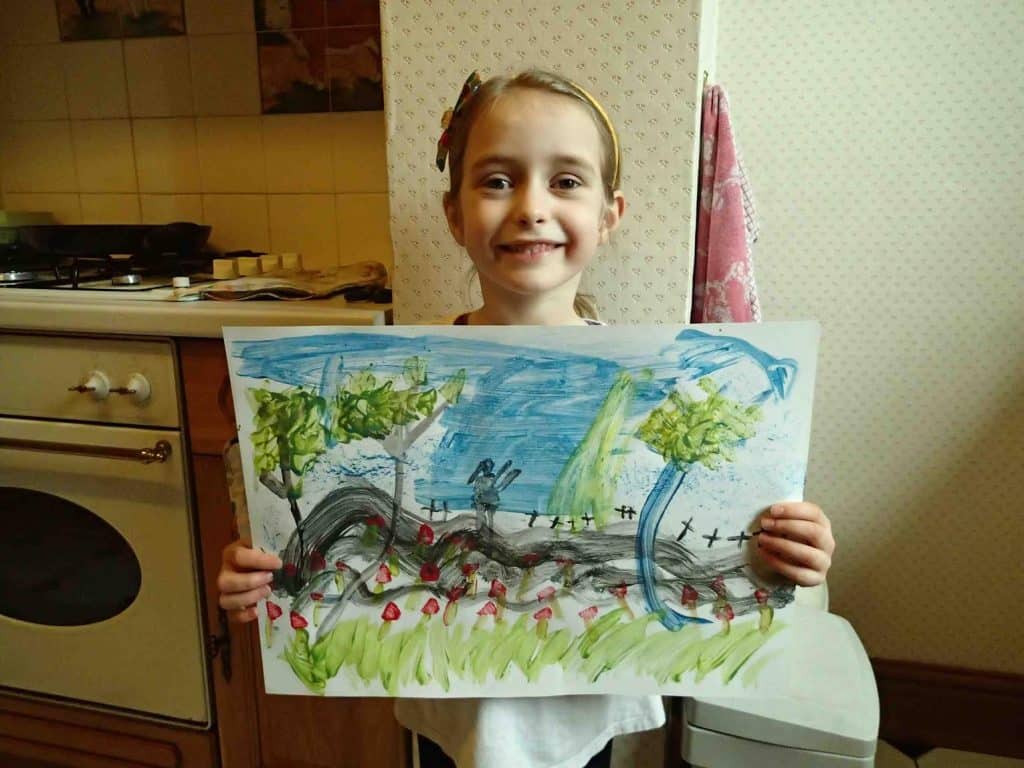
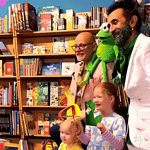
After the matinee I met so many lovely people who wanted of talk about the music and the pictures, the materials I used and the interpretation. I was overwhelmed by the warmth of the Manchester audience, the orchestra, everyone at Chetham’s, and conductor Steve Threlfall. One family subsequently sent pictures of how two girls reinterpreted the concert with their resourceful grandmother, after meeting me at the performance.
 Here’s some of the work produced by Rosie and Amelia. Aren’t they fantastic? this sort of engagement and following up fully justifies all the hard work put in by so many people.

A project like this which includes words, music and image covers so many creative areas. But this was also a reminder of the purpose of art. It’s not just about nice tunes and pretty pictures. War artists, composers and poets who died or suffered in the war, did so for a reason: to warn the future generations. Art is the most personal record of those terrible times. And I was humbled and moved to be able to reinterpret this music with such a magnificent orchestra of supremely talented youngsters.
There are some plans being discussed for a return to Manchester and Chetham’s at some point. I do hope that happens, as these few days were, for me, a pinnacle of what I believe in and fight for.
To find out more about Chetham’s, visit: http://www.chethams.com




Leave a Reply