

For 25 years I’ve been encouraging children, teachers and parents to celebrate art with the Katie books. The feedback has been tremendous, humbling, wonderful. More recently I’ve been trying to do the same for music. But not through books (at least not yet), but through presenting concerts of classical music for children with live illustrations, with the help and support and encouragement of some wonderful musicians, orchestras, conductors, festival directors and critics (thank you!)… and the response has been overwhelmingly positive.
There is a real identifiable need for this kind of event. Recently the BBC, recognising this need, created the Ten Pieces project, where selected pieces of music are explained in a film for primary schools, and the project is endorsed by various celebrities, in particular Nicola Benedetti, the wonderful violinist who does so much to support music education.
And it’s great.
The film is lavish, and well put together, with popular and experienced presenters and spectacular sound. You can see it here:
http://www.bbc.co.uk/iplayer/episode/b04lyj10/ten-pieces-03102014
But of course, it is only a starting point.
Children used to learn about classical music in primary schools. My own love of music comes from hearing the stories behind the music, played on scratchy old LPs by a music teacher; memories of days in the classroom, basking in the late afternoon sun, and daydreaming the pictures, the illustrations, that went with the music. It was wonderful. That’s when I first started drawing to music. And it continued at home. We didn’t have many LPs, but we had a few…

There are still great schools where they do hear music, perhaps in assembly. But there are also schools where the staff have no knowledge or interest in classical music. They are an overlooked generation perhaps. When I visit schools I always see the warning signs: in the assembly hall, the CDs by the hi-fi are all Disney songs, show tunes, easy listening. There is often no Mozart or Mussorgsky, no Bach or Berlioz, no Rossini or Rimsky-Korsakov. And I’m not trying to say classical music is “better” than other kinds. I enjoy all sorts of music. But equally, classical music certainly isn’t inferior just because it is old. It deserves to be heard.
It makes me sad because I know most of these children will not get to hear classical music at school or at home. Of course they may hear snippets in movies and adverts, where this majestic and wonderful music is often seen as nothing more than a bit of a joke. Is that really what the mighty Beethoven has been reduced to… advertising pizza?
My fight is to grab the music back and give it to the children in a context that makes sense to them and is true to the composer, and shows them the power, beauty, and emotion in music. As the great Plato said: “Music gives a soul to the universe, wings to the mind, flight to the imagination.”
This area of music education is so often overlooked. It is about music appreciation. Not everyone will be a concert pianist, but (almost) everyone can be a member of an audience, and enjoy listening to music… But it will only happen with education and opportunity. And if they don’t inherit preconceptions.
This year I have visited dozens of schools, several for the Cheltenham Music Festival outreach education programme, offering music and art workshops. With storytelling, art demonstrations and a CD, I’ve been getting children to paint to music. Hardly a new concept, some schools do this already (albeit usually as an abstract response rather than illustrative). Where my workshop differs is that I carefully choose narrative story music and so the children get story as well as art and music in the whole mix. It’s very cross curricular, for there is history, geography and science in there too if you look.

The reaction at every school has been: fantastic, how do we follow up? We’d love to do more!
Children across the board, of every colour, language and race and economic background have been transfixed by music, lost in their art. This isn’t some middle-class project for nice schools. I’ve deliberately been to the whole range of schools: where troubled children, scared of drawing, have created art with complete concentration; autistic children have joined in and triumphed; in one school an elective mute emerged from silence to paint a masterpiece and then TALK to me about the music! I can’t even begin to tell you how moved the teachers and I were. And this isn’t because of me… it is the MUSIC – that most universal language.
But the teachers, even music specialists, are often insecure about how to do more of this sort of thing. Finding the stories, developing the art responses, selecting the best music…. It takes time. It takes someone who is interested enough to care.
I fear that without help, for many teachers, it will be a challenge to know how to use the information in the BBC Ten Pieces. So many adults are, frankly, scared of something they know nothing about and never had the opportunity to experience. They feel it is not “their world”. They are scared of the highbrow label. Teachers need more help!
Beyond the classroom, where does this music education lead? What is the point of it? Quite apart from possible careers (management, publicity, art, design, writing opportunities, performance – it’s an inspiring range), it also leads to that intangible concept: enrichment. Put simply, art, as a mirror of humanity, makes us better people, helps us understand our world, and records our history. Music moves us, and communicates in a way that nothing else really can.
What the BBC Ten Pieces scheme does brilliantly, is highlight the need for audiences as well as players.
And after seeing the film, where do audiences go next?
The BBC Children’s Prom this year was, I hear from a conductor, not ideal, with the ambient audience noise in the Albert Hall drowning out most of the music, which was mainly only piece-meal extracts. Smaller venues are usually better for children, I think. Most family concerts seem to focus on getting orchestras to be “cool” by playing music from Star Wars or Dr Who, etc. And the emphasis is always on fun. Being funny, being jokey. All well and good, there’s a place for that. But live classical music is SO MUCH MORE!
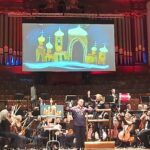
That’s why I continue to work so hard with the concerts I present, because usually orchestras play full works, carefully selected. I spend weeks (and I do mean weeks) researching stories (so that audiences don’t have to) and then I paint illustrations (also carefully choreographed, rehearsed and prepared) live on stage as the music plays.
In these times of austerity, getting arts events off the ground is incredibly hard. Keeping them affordable for children is a huge challenge. Lots of music festivals, like Cheltenham for example, offer wonderful events for children and families with tickets often less than the cost of a trip to the cinema. My own concerts are always as affordable as possible. But they can only survive if audiences engage and actually come. And that’s what we need: families to take that step into a world they may not understand, with mind (and ears!) open. The rewards are infinite.
So, I hope after seeing the Ten Pieces film, parents, teachers and children will attend more live music events. There are many other concerts with presenters and animateurs up and down the country, different approaches, different styles, all with the same aim: to share this music that we love so much. Even if you think classical music is not for you, I hope you will give it a go. Take a risk. There is a whole world of music and story, adventure and surprise, beauty and horror, and even humour… waiting for you to dive in and make your own.
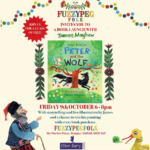
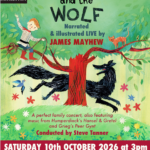
And for those interested in my concerts, click below for links to those that are coming up :
HEROES & VILLAINS – Copland, Grieg and Rossini (November 9th)
And I’ve run out of things to say now, so I’m off to listen to some music to prepare for the concerts. For as Hans Christian Anderson said: “Where words fail, music speaks.”



Leave a Reply